
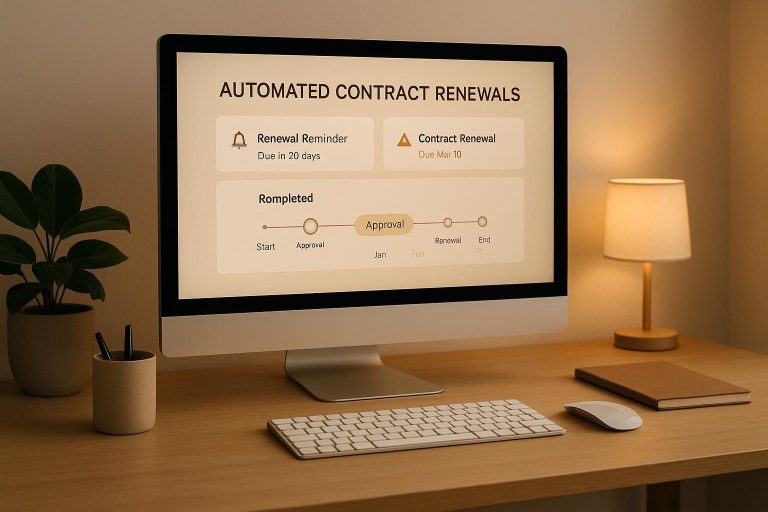
Automating contract renewals can save time, reduce errors, and avoid costly penalties. Manual processes often lead to missed deadlines and inefficiencies, but automation tools centralize data, send timely alerts, and streamline workflows. Here’s how businesses can simplify renewals:
- Centralized Dashboards: Keep all contracts in one place, track deadlines, and access key terms instantly.
- Smart Alerts: Get timely notifications and trigger workflows to ensure reviews and approvals happen on time.
- Spend Analysis: Identify wasteful expenses, optimize vendor portfolios, and cut unnecessary costs.
- Integrated Systems: Connect finance, procurement, and IT tools for better data accuracy and collaboration.
- Automated Policies: Set clear approval thresholds to speed up routine renewals and flag high-risk contracts.
- Inbox Automation: Extract key renewal details from emails and organize them efficiently.
- Performance Dashboards: Track metrics like renewal rates and missed deadlines to improve processes.
Key Fact: Businesses using automation have cut contract management costs by up to 60%. Tools like bizSupply offer centralized solutions to manage renewals, reduce risks, and save money.
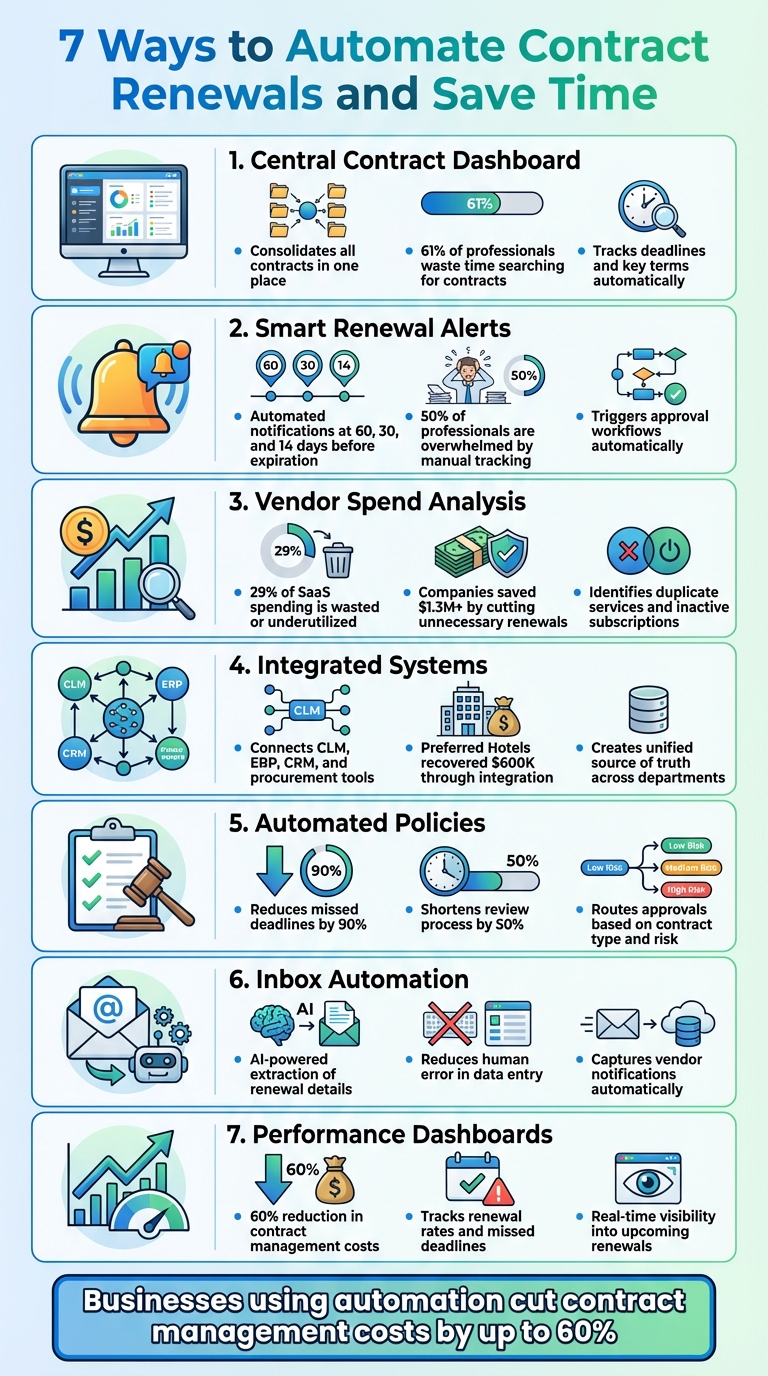
7 Ways to Automate Contract Renewals and Save Time
1. Use a Central Contract Dashboard with Automated Tracking
Relying on manual spreadsheets and email folders to manage contract renewals can quickly spiral into chaos. Did you know that 61% of contract professionals spend time every week searching for contracts just to prepare for renewals? On top of that, more than half waste even more time trying to track down renewal terms. This scattered approach isn’t just inefficient – it can lead to missed deadlines and costly auto-renewals that could have been avoided altogether.
A central contract dashboard solves this problem by putting everything you need in one place. It consolidates all your contracts, giving you instant access to key details like renewal dates, notice periods, and terms. No more manual updates or last-minute scrambling. The system keeps track of deadlines for you, automatically sending alerts to the right teams – whether that’s Legal, Finance, or Procurement – well ahead of time. Plus, it flags high-risk clauses like auto-renewals, price increases, or outdated insurance requirements and pairs that information with spending history and vendor performance data. This way, your team has all the context they need to make smart, informed decisions about renewals.
Take bizSupply’s centralized dashboard, for example. It imports contracts, tracks deadlines, and sends timely reminders to prevent unpleasant surprises. Need to find a specific clause, like "termination" or "price escalation"? You can search for it directly without wading through endless documents.
With everything organized in one place, you eliminate the stress of missed deadlines, endless searches, and unexpected financial hits. The dashboard ensures that every critical detail is accessible from anywhere, setting the stage for smarter workflows and better renewal management.
2. Set Up Smart Renewal Alerts and Decision Workflows
Trying to manually track dozens – or even hundreds – of contracts can quickly spiral out of control. In fact, about 50% of professionals find themselves overwhelmed by this task. Relying on paper notes, spreadsheets, or mental reminders often leads to missed deadlines, especially when juggling varying notice periods and overlapping renewal dates.
That’s where automated renewal alerts come in. These alerts notify the right people at the right time – whether it’s 60, 30, or even 14 days before a contract expires. But they don’t just stop at reminders. They kick off approval workflows, ensuring that tasks are routed to the appropriate departments, like Legal, Finance, or Procurement. This way, contracts are reviewed, renegotiated, or terminated on schedule. If the process slows down, automated follow-ups nudge things along, keeping everything on track. This kind of proactive system can translate into real savings.
Take Jennifer Neville, Associate Corporate General Counsel at Sevita, for example. By using automated tracking, she not only saved countless hours but also avoided unnecessary costs on contracts that were better off terminated. It’s a stark contrast to the financial drain of letting a contract auto-renew without review.
To make these workflows even more effective, advanced customization options allow you to tailor alerts to specific needs. For instance, bizSupply’s smart alert system provides intuitive calendar views and color-coded reports, making it easy to spot upcoming deadlines at a glance. You can also set up specialized triggers – like a "Notice Date Approaching" alert for standard contracts or an "Evergreen Annual Review" for open-ended agreements. These tools ensure no deadline slips through the cracks.
What’s more, these alert systems integrate seamlessly with a centralized contract management dashboard, giving your team a clear, real-time overview. They also maintain a detailed audit trail, so you can track exactly who reviewed what and when. It’s all about keeping your team informed, efficient, and ahead of the game.
3. Automate Vendor Spend Analysis for Cost Savings
Every contract portfolio hides costs that quietly chip away at budgets. Think overpriced agreements, duplicate services, or inactive subscriptions – these are the culprits manual tracking often overlooks. In fact, 29% of SaaS software spend is underutilized or wasted. That’s almost a third of your budget disappearing without adding any value.
Automated spend analysis offers a solution by pulling together spend-related data, usage stats, and historical records into one centralized view. Forget juggling spreadsheets and invoices – this approach identifies outdated pricing, redundant vendors, and subscriptions that aren’t being used. The results speak for themselves: businesses adopting these tools have saved over $1.3 million by cutting unnecessary renewals and optimizing vendor portfolios. Beyond simplifying data management, this method sets the stage for smarter, more informed negotiations.
When it’s time to renew contracts, automated systems provide a clear picture by consolidating spend history, performance data, and contract terms. This empowers your negotiation team with the insights they need to benchmark vendor pricing, eliminate underperforming services, and consolidate vendors for better leverage. Tools like bizSupply combine contracting data with spending patterns, removing the guesswork and manual effort from the process.
"Without regular contract reviews, businesses often end up paying for services they don’t need or use." – Spendflo
Companies leveraging these solutions have achieved a 60% reduction in contract management costs. By automating the detection of underused services and enabling renegotiations based on hard data, you’re not just saving time – you’re recovering dollars that would otherwise be lost.
4. Connect Renewal Automation with Finance, Procurement, and IT Systems
Relying on manual data entry between departments often leads to expensive mistakes, miscommunication, and inefficiencies. When your contract renewal system operates in isolation, it can create significant challenges: finance teams might miss critical budget forecasts, procurement may struggle to monitor vendor performance, and IT could lose track of software licenses and compliance.
Integrating automated data flow across platforms like CLM, ERP, CRM, and procurement tools can solve these issues by creating a unified source of truth. Finance teams benefit from automated prepaid entries, procurement gains real-time insights into pricing and delivery, and IT achieves full visibility into the software stack, license usage, and compliance certifications. This kind of integration not only improves data accuracy but also lays the groundwork for measurable operational gains.
The impact of such integration is clear. Preferred Hotels, for example, faced over $500,000 in missed or late payment collections over four years. By implementing integrated automation, they started generating more than 200 standardized contract reports monthly, recovering $600,000 and increasing member retention to 95%.
"The automation has transformed our renewal process. What used to take weeks now happens automatically, and we have not missed a single renewal deadline."
- Hunter D., Contract Operations Director, Global Enterprises Inc
Platforms like bizSupply help bridge the gap, connecting contract data with your existing tech stack and removing operational bottlenecks. Automated workflows streamline the sharing of critical information across departments, enabling smoother collaboration. Additionally, integrated systems enable self-service renewals by granting every team the access they need to stay informed. These workflows empower teams with instant access to essential data, driving efficiency and accuracy across the board.
sbb-itb-291cea0
5. Set Up Automated Policies, Playbooks, and Approval Thresholds
After integrating systems across departments, the next step is automating approval policies to make contract renewals smoother and faster.
Manual approval processes often lead to confusion about who needs to sign off and when. Automated policies cut through this uncertainty by setting clear rules that direct renewals to the right people. For instance, when it’s time to renew a contract, the system automatically triggers a workflow tailored to the contract type or its level of risk.
"Renewal delays often happen because no one knows who needs to approve what – or when." – ContractSafe
By implementing automated approval thresholds, routine renewals can move forward quickly, while more complex agreements are flagged for additional review. This approach not only reduces missed deadlines by up to 90% but also shortens the review process by 50%.
Conditional routing ensures that no task falls through the cracks. If a stakeholder doesn’t respond within a set timeframe, the system escalates the task to their manager. For example, once Legal gives the green light on a contract, Finance is immediately notified to assess any budget implications. After all necessary approvals are secured, the system alerts the designated individual to finalize the agreement using e-signature tools. This end-to-end automation keeps every step of the renewal process on track and error-free.
With bizSupply, this entire workflow is seamlessly managed. It connects approval chains to your existing systems, ensuring stakeholders can respond quickly and efficiently.
6. Use Inbox and Workflow Automation Tools
Keeping track of contract renewal details in a crowded email inbox can feel like searching for a needle in a haystack. Important vendor notifications and critical contract information often get buried in endless threads, making manual tracking both time-consuming and error-prone. That’s where automated inbox tools come in – they simplify this process by automatically capturing contract-related emails and pulling out key renewal details.
These tools save you from chasing down scattered agreements stored in emails, shared drives, or personal folders. Thanks to AI-powered extraction, they can identify essential information – like expiration dates, payment terms, and vendor contacts – and organize it all into a single, easy-to-access view of your renewal communications.
One of the biggest advantages? They help reduce human error. By automating data entry, these tools ensure that deadlines are met and mistakes are minimized. For example, when a vendor sends a renewal notice, the system can log the email, update the contract record, and kick off the right workflow. Whether it’s notifying procurement, flagging budget issues, or routing the message for approval, everything happens seamlessly. Plus, this integration works hand-in-hand with your centralized dashboard, keeping your contract data accurate and up-to-date.
Take bizSupply’s Chrome extension as an example. It brings vendor insights and contract details straight into your inbox. With this tool, you can easily view renewal dates, spending trends, and potential savings – all without ever leaving your email client. It’s a simple way to make sure no important detail slips through the cracks.
7. Track Renewal Performance with Dashboards and KPIs
Once you’ve automated contract renewals, the next step is to keep a close eye on how well the process is working. Real-time dashboards are a game-changer here, offering instant insights into your renewal performance. They let you quickly identify problems or opportunities without waiting for manual reports to catch up.
Focus on tracking key metrics like contract renewal rate (percentage of contracts renewed versus expired), days until expiration, and upcoming renewals – broken down into 30, 60, 90, and 120-day windows. Other important metrics include renewal cycle time, cost savings achieved, and missed deadlines. These numbers highlight bottlenecks and inefficiencies that could be holding your process back. For example, Deloitte reports that implementing contract analytics tools can lead to a 60% reduction in contract management costs.
Automated dashboards also remove the risk of human error tied to manual data entry. This is critical because, as Flexera’s State of ITAM report shows, 29% of SaaS software spending goes underutilized or wasted. Dashboards simplify complex data, turning it into actionable insights. A great example? Funding Circle managed to save about $1 million by centralizing records and automating their workflows.
Take bizSupply’s centralized dashboard, for instance. It consolidates all your renewal metrics in one place, making it easier to spot contracts that need attention, evaluate your team’s performance against renewal goals, and uncover areas for improvement. And the best part? It eliminates the need to manually create reports, saving you both time and effort while keeping your process on track.
Conclusion
Streamlining contract renewals through automation is no longer just a convenience – it’s a necessity for businesses looking to stay competitive. With 90% of legal professionals reporting difficulties in locating individual contracts in manual systems, and the average cost of a data breach reaching $4.88 million, outdated processes pose risks that can’t be ignored.
The automation strategies outlined earlier address these challenges head-on. By eliminating tedious manual data entry and repetitive tasks, your team can focus on building stronger vendor relationships. Plus, automation reduces costly mistakes like missed deadlines, unintended auto-renewals, and compliance issues. For example, Oxford Properties Group cut lease document versions by 80%, while Luminus sped up their contract generation process, saving sales reps an entire day each week.
"Automation isn’t just about efficiency; it’s about empowering your business to thrive in a competitive landscape." – ConvergePoint
bizSupply brings all these automation tools together in one centralized platform. With features like smart renewal alerts, automated vendor spend analysis, integrated workflows, and real-time performance dashboards, you can manage contract renewals with ease. This all-in-one solution ensures renewals are optimized, risks are minimized, and your business is set up for success.
FAQs
How can a centralized contract dashboard simplify renewal management?
A centralized contract dashboard makes managing renewals much easier by providing a clear, organized overview of all your contracts in one place. You can set up automated alerts for approaching deadlines, monitor renewal statuses as they happen, and simplify approval workflows.
With everything in one spot and automation taking care of repetitive tasks, you can cut down on missed deadlines, reduce manual mistakes, and enhance team collaboration. This helps ensure renewals are completed on time, lowers risks, and saves you precious time.
What are the advantages of connecting contract renewal automation with other systems?
Integrating contract renewal automation with other systems brings a host of advantages. For starters, it simplifies your workflows by cutting down on delays and boosting efficiency. When platforms share data effortlessly, you can maintain better accuracy and consistency throughout your operations.
Automation also reduces the chances of missing deadlines or making errors, making contract management much smoother. The result? You save valuable time while fostering stronger relationships with clients and vendors, thanks to timely and dependable renewals.
How does automated spend analysis help save money during contract renewals?
Automated spend analysis is a game-changer when it comes to managing costs during contract renewals. It pinpoints unnecessary or overpriced expenses, giving businesses a clear understanding of where their money is going. With this insight, companies can negotiate more effectively with vendors and ensure their contracts align with both their budget and specific needs.
Beyond cost savings, these tools simplify the review process, making it easier to stay compliant with contract terms. This reduces the risk of penalties or overlooked savings opportunities. The result? You save time and get more value out of your contracts in the long run.